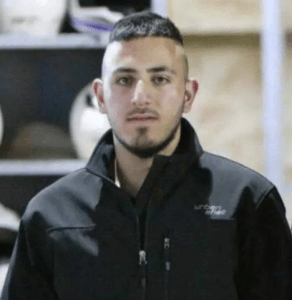
Aws Salama

July 12, 2017: Aws Mohammad Salama, 17, was killed by Israeli soldiers who invaded Jenin refugee camp, in the northern West Bank governorate of Jenin, and fired dozens of live rounds and gas bombs, during clashes that took place following the invasion.

The soldiers also shot Sa’ad Hasan Salah, 21, from Jenin refugee camp, with three live rounds, including one in the head, before he succumbed to his wounds on the operating table in a hospital in Jenin.

The Israeli army claimed that many Palestinian protesters hurled homemade explosives and Molotov cocktail on the military vehicles.

A third Palestinian, identified as Odai Nizar Abu Na’sa, 19, was seriously injured, after the soldiers shot him with an expanding bullet in his leg. Aws was from Jenin refugee camp.

The Palestinian Center for Human Rights (PCHR) issued a statement strongly condemning the excessive use of force by the Israeli military, and affirming that the two Palestinians were not part of any clashes which broke out between the Palestinian civilians and Israeli soldiers. Source: IMEMC

Sa’ed Salah

July 12, 2017: Sa’ed Nasser Salah, 20, was killed by Israeli soldiers who invaded Jenin refugee camp, in the northern West Bank governorate of Jenin, and fired dozens of live rounds and gas bombs, during clashes that took place following the invasion.

Sa’ad was shot with three live rounds, including one in the head, and succumbed to his wounds on the operating table in a hospital in Jenin.

He has three brothers; one of them, Yousef, is imprisoned by Israel, and one is a former political prisoner, while their father became paralyzed several years ago, after the soldiers shot him in his spine.

During the invasion, the soldiers also killed Aws Mohammed Yousif Salamah, 17, from Jenin refugee camp, after shooting them with live fire.

The Israeli army claimed that many Palestinian protesters hurled homemade explosives and Molotov cocktail on the military vehicles.

A third Palestinian, identified as Odai Nizar Abu Na’sa, 19, was seriously injured, after the soldiers shot him with an expanding bullet in his leg. Sa’ad was from Jenin city.

The Palestinian Center for Human Rights (PCHR) issued a statement strongly condemning the excessive use of force by the Israeli military, and affirming that the two Palestinians were not part of any clashes which broke out between the Palestinian civilians and Israeli soldiers. Source: IMEMC

Mohammad Jibreel

July 10, 2017: Mohammad Ibrahim Jibreel, 25, was killed by Israeli soldiers near Teqoua’ town, southeast of Bethlehem, in the West Bank.

The Israeli army claimed that Mohammad attempted to ram soldiers with his car, while they were exchanging guard duties at a military watchtower, wounding one.

The army added that the car struck a nearby safety rail, before the driver reportedly exited it while carrying a knife, and “attempted to stab the soldiers,” who then shot him dead.

A Palestinian ambulance rushed to the scene, but the soldiers prevented the medics from approaching the young Palestinian man. Mohammad was from Teqoua’ town. Source: IMEMC

Abdul-Rahman Barghouthi

July 07, 2017: Abdul-Rahman Mahmoud Barghouthi, 18 months, died from the severe effects of teargas inhalation after Israeli soldiers invaded Aboud village, northwest of Ramallah in central West Bank, and fired many gas bombs.

The toddler was injured in May, before he was moved to a Palestinian hospital in Ramallah, and was later transferred to Hadassah Israeli Medical Center in Jerusalem, where he died from his serious wounds.

Local sources in Aboud said the soldiers invaded the village and attacked Palestinian protesters, before firing dozens of gas bombs at them and many homes, causing several Palestinians to suffer the effects of teargas inhalation.

Volunteers with the Palestinian Civil Defense said they rushed to the toddler’s home when he was injured, but could not drive to the property after the soldiers stopped their ambulance, an issue that forced them to run to the home, and carry the child all the way back to the ambulance. Abdul-Rahman was from Aboud. Source: IMEMC

Eyad Gheith

June 28, 2017: Eyad Monir Gheith, 23, was killed by undercover Israeli soldiers who infiltrated into Jabal Johar area, south of Hebron city, in the southern part of the West Bank.

The Israeli army claimed that the undercover soldiers were searching for weapons when they “came under fire, and fired back, killing one Palestinian.” The army reported no injuries among the soldiers.

The Palestinian Health Ministry said the Palestinian was shot with several live rounds in his chest, and in other parts of his body, causing instant death.

Palestinian medics rushed to the scene and moved his corpse to Mohammad Ali Al-Mohtasib governmental hospital, in Hebron city. Source: IMEMC

Baha’ al-Harbawi

June 20, 2017: Baha’ Samir al-Harbawi, 23, was killed by Israeli soldiers near Jaba’ military roadblock, northeast of East Jerusalem, after the soldiers claimed that he attempted to stab them while they were conducting routine searches. The Israeli army said the incident caused no injuries among the soldiers.

Following the fatal shooting, the army closed the area, and isolated it, while more troops were deployed around it, especially around Palestinian communities north of Jerusalem, and in the northern part of the West Bank.

The soldiers also invaded the town of al-‘Ezariyya, east of Jerusalem, and abducted Emad al-Harbawi, the father of the slain Palestinian, after storming his home and searching it, and took him to a detention and interrogation center in Ma’ale Adumim settlement.

The family denied the military allegations and said that Baha’ left al-‘Ezariyya after finishing his work in the evening, and was heading to Ramallah to visit his brother, and to shop there.

Baha’ was never detained and imprisoned by Israel before his death, and had no political affiliation. Baha’ was from al-‘Ezariyya, east of Jerusalem. Source: IMEMC

Osama Ata

June 16, 2017:  Osama Ahmad Ata, 19, was killed by Israeli soldiers and border police who opened fire upon him and two others after an Israeli border officer was stabbed in Sultan Suleiman Street, near Damascus Gate in Jerusalem. The Israeli border officer, Hadas Malka, was killed, and another was wounded. In addition to Ata, two other Palestinians were killed: Bara’ Ibrahim Saleh, 18, and Adel Hasan Ankoush, 18, all from Deir Abu Mashal village, west of Ramallah, in central West Bank.

Following the incident, dozens of Israeli soldiers and officers were deployed in the area, closed all the gates leading to Jerusalem’s Old City, and assaulted many Palestinians, especially in the areas leading to the Al-Aqsa Mosque.

The soldiers also assaulted many Palestinians, and clashed with local youths, wounding many with live fire and rubber-coated steel bullets.

One of the wounded Palestinians was shot with a live round in his spine, and another round in his kidney. He was picked up by an ambulance, and the soldiers chased the ambulance to the Al-Makassed Hospital in Jerusalem, where they tried to invade the hospital. But dozens of Palestinians clashed with them, and prevented them from entering the hospital.

In addition, dozens of soldiers surrounded and completely isolated Deir Abu Mashal village. Local sources said the soldiers imposed a strict siege on the village.

The soldiers warned that they would shoot and kill any Palestinian who seen walking outside at night, and that the siege would continue until further notice. The curfew came in the middle of the month of Ramadan, when Palestinian Muslims fast during the day, and eat and drink only at night.

According to an investigation by the Palestinian Center for Human Rights, at approximately 05:30 on Saturday, 17 June 2017, Israeli forces moved into the said village and imposed a curfew. 11:37PM

According to PCHR’s investigations, at approximately 05:30 on Saturday, 17 June 2017, Israeli forces moved into the said village and imposed a curfew. The Israeli soldiers accompanied by an engineering team raided the houses belonging to the families of the three attackers and surveyed them for future demolition. Before withdrawal, the Israeli forces handed notices to the owners of the homes where the now-deceased teens lived, saying that their homes will be demolished at an unspecified date, as part of the collective punishment against attackers’ families. Ata was from Deir Abu Mashal village, west of Ramallah, in central West Bank. Source: IMEMC.

Adel Ankoush

Adel AnkoushJune 16, 2017:  Adel Hasan Ankoush, 18, was killed by Israeli soldiers and border police who opened fire upon him and two others after an Israeli border officer was stabbed in Sultan Suleiman Street, near Damascus Gate in Jerusalem. The Israeli border officer, Hadas Malka, was killed, and another was wounded. In addition to Ankoush, two other Palestinians were killed: Bara’ Ibrahim Saleh, 18, and Osama Ahmad Ata, 19, all from Deir Abu Mashal village, west of Ramallah, in central West Bank.

Following the incident, dozens of Israeli soldiers and officers were deployed in the area, closed all the gates leading to Jerusalem’s Old City, and assaulted many Palestinians, especially in the areas leading to the Al-Aqsa Mosque.

The soldiers also assaulted many Palestinians, and clashed with local youths, wounding many with live fire and rubber-coated steel bullets.

One of the wounded Palestinians was shot with a live round in his spine, and another round in his kidney. He was picked up by an ambulance, and the soldiers chased the ambulance to the Al-Makassed Hospital in Jerusalem, where they tried to invade the hospital. But dozens of Palestinians clashed with them, and prevented them from entering the hospital.

In addition, dozens of soldiers surrounded and completely isolated Deir Abu Mashal village. Local sources said the soldiers imposed a strict siege on the village.

The soldiers warned that they would shoot and kill any Palestinian who seen walking outside at night, and that the siege would continue until further notice. The curfew came in the middle of the month of Ramadan, when Palestinian Muslims fast during the day, and eat and drink only at night.

According to an investigation by the Palestinian Center for Human Rights, at approximately 05:30 on Saturday, 17 June 2017, Israeli forces moved into the said village and imposed a curfew. 11:37PM

According to PCHR’s investigations, at approximately 05:30 on Saturday, 17 June 2017, Israeli forces moved into the said village and imposed a curfew. The Israeli soldiers accompanied by an engineering team raided the houses belonging to the families of the three attackers and surveyed them for future demolition. Before withdrawal, the Israeli forces handed notices to the owners of the homes where the now-deceased teens lived, saying that their homes will be demolished at an unspecified date, as part of the collective punishment against attackers’ families. Ankoush was from Deir Abu Mashal village, west of Ramallah, in central West Bank. Source: IMEMC.

Bara’ Saleh

Bara Ibrahim SalehJune 16, 2017: Bara’ Ibrahim Saleh, 18, was killed by Israeli soldiers and border police who opened fire upon him and two others after an Israeli border officer was stabbed in Sultan Suleiman Street, near Damascus Gate in Jerusalem. The Israeli border officer, Hadas Malka, was killed, and another was wounded. In addition to Saleh, two other Palestinians were killed: Adel Hasan Ankoush, 18, and Osama Ahmad Ata, 19, all from Deir Abu Mashal village, west of Ramallah, in central West Bank.

Following the incident, dozens of Israeli soldiers and officers were deployed in the area, closed all the gates leading to Jerusalem’s Old City, and assaulted many Palestinians, especially in the areas leading to the Al-Aqsa Mosque.

The soldiers also assaulted many Palestinians, and clashed with local youths, wounding many with live fire and rubber-coated steel bullets.

One of the wounded Palestinians was shot with a live round in his spine, and another round in his kidney. He was picked up by an ambulance, and the soldiers chased the ambulance to the Al-Makassed Hospital in Jerusalem, where they tried to invade the hospital. But dozens of Palestinians clashed with them, and prevented them from entering the hospital.

In addition, dozens of soldiers surrounded and completely isolated Deir Abu Mashal village. Local sources said the soldiers imposed a strict siege on the village.

The soldiers warned that they would shoot and kill any Palestinian who seen walking outside at night, and that the siege would continue until further notice. The curfew came in the middle of the month of Ramadan, when Palestinian Muslims fast during the day, and eat and drink only at night.

According to an investigation by the Palestinian Center for Human Rights, at approximately 05:30 on Saturday, 17 June 2017, Israeli forces moved into the said village and imposed a curfew. 11:37PM

According to PCHR’s investigations, at approximately 05:30 on Saturday, 17 June 2017, Israeli forces moved into the said village and imposed a curfew. The Israeli soldiers accompanied by an engineering team raided the houses belonging to the families of the three attackers and surveyed them for future demolition. Before withdrawal, the Israeli forces handed notices to the owners of the homes where the now-deceased teens lived, saying that their homes will be demolished at an unspecified date, as part of the collective punishment against attackers’ families. Saleh was from Deir Abu Mashal village, west of Ramallah, in central West Bank. Source: IMEMC.

Hadas Malka

Hadas MalkaJune 16, 2017: Hadas Malka, 23, was killed by three Palestinians who stabbed and opened fire at Israeli soldiers in Sultan Suleiman Street, near Damascus Gate in Jerusalem. Malka, who was an active duty Israeli border police officer, was stabbed while trying to reach for her gun.

Hadas was critically injured, and later died of her wounds at Shaare Zedek Medical Center in Jerusalem.

Another Israeli soldier was wounded in the attack, and the three Palestinians were all shot dead.

The soldiers first killed the Palestinian who reportedly stabbed Malka, and killed two others who used guns and knives to attack the group of soldiers.

The three slain Palestinians have been identified as Bara’ Ibrahim Saleh, 18, Adel Hasan Ankoush, 18, and Osama Ahmad Ata, 19, all from Deir Abu Mashal village, west of Ramallah, in central West Bank.

Following the incident dozens of Israeli soldiers and officers were deployed in the area, closed all the gates leading to Jerusalem’s Old City, and assaulted many Palestinians, especially in the areas leading to the Al-Aqsa Mosque.

The soldiers also assaulted many Palestinians, and clashed with local youths, wounding many with live fire and rubber-coated steel bullets.

One of the wounded Palestinians was shot with a live round in his spine, and another round in his kidney. He was picked up by an ambulance, and the soldiers chased the ambulance to the Al-Makassed Hospital in Jerusalem, where they tried to invade the hospital. But dozens of Palestinians clashed with them, and prevented them from entering the hospital.

In addition, dozens of soldiers surrounded and completely isolated Deir Abu Mashal village.

The soldiers warned that they would shoot and kill any Palestinian who seen walking outside at night, and that the siege would continue until further notice. The curfew came in the middle of the month of Ramadan, when Palestinian Muslims fast during the day, and eat and drink only at night.

According to an investigation by the Palestinian Center for Human Rights (PCHR), at approximately 05:30 on Saturday, 17 June 2017, Israeli forces moved into the said village and imposed a curfew.

According to PCHR’s investigations, at approximately 05:30 on Saturday, 17 June 2017, Israeli forces moved into the said village and imposed a curfew. The Israeli soldiers accompanied by an engineering team raided the houses belonging to the families of the three attackers and surveyed them for future demolition. Before withdrawal, the Israeli forces handed notices to the owners of the homes where the now-deceased teens lived, saying that their homes will be demolished at an unspecified date, as part of the collective punishment against attackers’ families. Malka was from Moshav Givat Azer in central Israel. Source: IMEMC